

At the Paris Institute of Psychiatry and Neuroscience (IPNP), where researchers work collaboratively to better understand how the brain functions, Wafa Ghoul is one of a new generation of scientists seeking to shed light on the origins of psychiatric disorders through the study of DNA. Her work contributes to improving recognition of these conditions, which are still widely stigmatized in society. Thanks to a joint call for projects between Université Paris Cité (UPCité) and the University of Toronto, she has been able to expand her research internationally—an experience that has profoundly shaped her both professionally and personally.
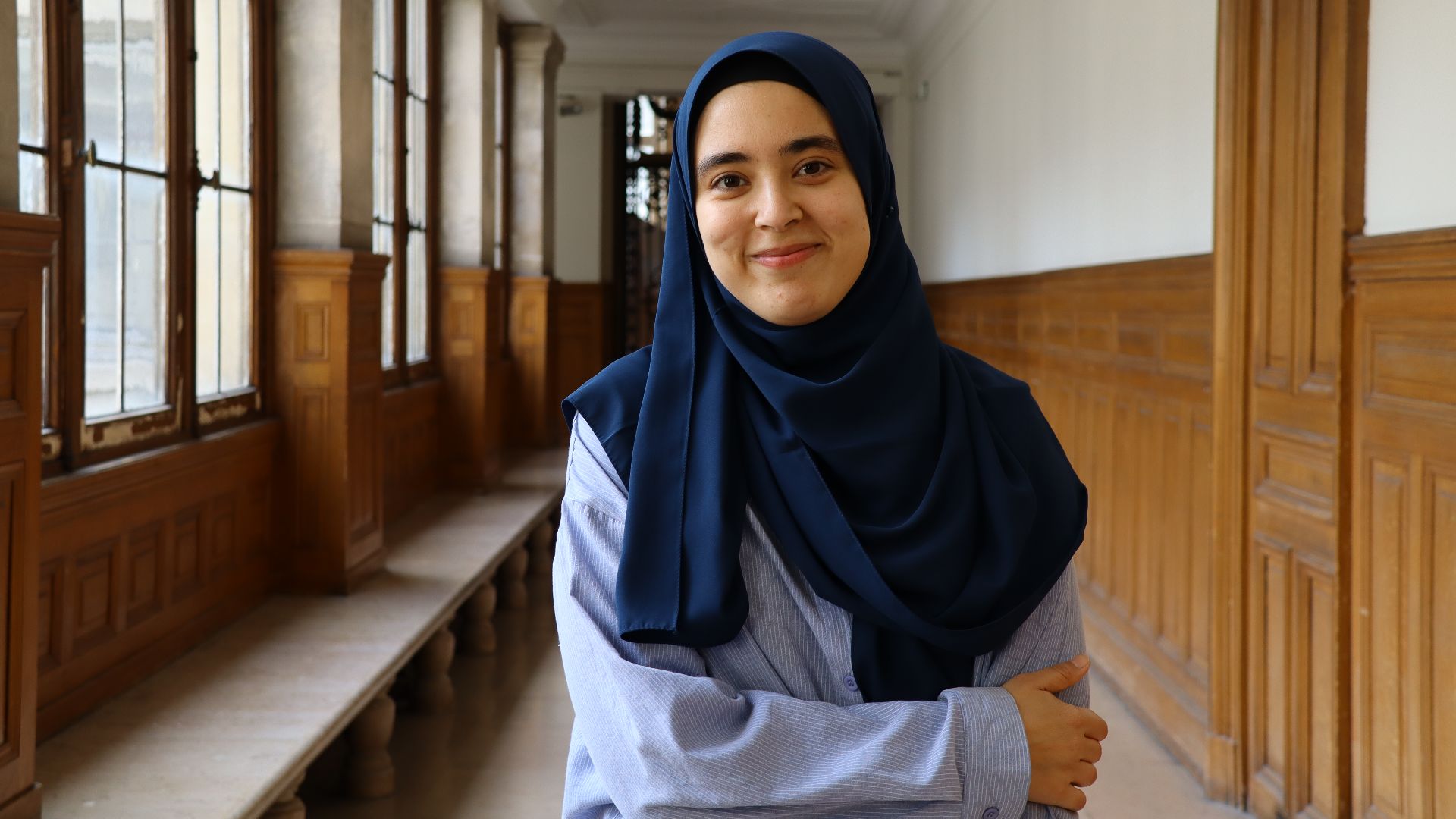
Wafa Ghoul, second-year PhD student at the Paris Institute of Psychiatry and Neuroscience.
Exploring psychiatric disorders through DNA
A PhD candidate at Université Paris Cité, Wafa began her journey into psychiatry during her master’s internship at IPNP in 2023.
“I was interested in human genetics, but psychiatry attracted me because it’s a rapidly evolving field with so much still to discover.”
Driven by a strong desire to learn, she chose to pursue her PhD at IPNP. Her research focuses on studying the DNA of patients with psychiatric disorders, particularly catatonia, to better understand what is happening in their bodies.
“Catatonia is a disorder that affects movement and behavior. It is a rare psychomotor condition. Patients may have difficulty interacting: they may either stop moving altogether or, on the contrary, enter a state of extreme agitation. It can develop for people with schizophrenia or bipolar disorder.”
At the heart of her research on movement and behavioral disorders, Wafa explores different “layers” of DNA.
“The idea is to analyze the DNA found in the cell nucleus, as well as mitochondrial DNA and the epigenetic profile, in order to understand the impact of the environment on these patients.”
In practice, she works on both nuclear DNA and mitochondrial DNA, which is found in mitochondria—the structures responsible for producing the energy needed for cells to function, particularly brain cells. She also studies the epigenetic profile, which helps explain how environmental factors can influence gene activity. Factors such as stress or lifestyle may therefore play a role in the development of disorders and help explain why some individuals are more affected than others.
Beyond genetic data analysis, Wafa’s research also raises important societal and public health issues. It contributes to changing perceptions of psychiatric illnesses by improving patient care, refining diagnoses, and ultimately helping to develop more targeted and personalized treatments.
“Whether in the media or popular culture, people with psychiatric disorders are often seen as ‘crazy,’ simply because we didn’t understand the biological or genetic mechanisms behind these conditions. In reality, they are diseases like any other, such as cancer or cardiovascular diseases. They must be taken seriously, and patients deserve the same level of medical attention.”
A first step onto the international stage
Wafa’s work took on a new dimension in 2024. Her PhD supervisor, psychiatrist and researcher Boris Chaumette, encouraged her to continue her analysis of mitochondrial DNA and to join an international collaborative project. Entitled “Mitochondrial Gene Risk in Psychiatric Disorders: A Transatlantic Educational and Research Collaboration,” the program is supported by UPCité and the University of Toronto through a joint call for projects aimed at fostering international research, particularly for early-career researchers.
The team led by Professor Ana Andreazza from the University of Toronto was welcomed at UPCité in March 2025. A few months later, in October, Wafa traveled to Toronto herself—her first experience in North America—where she discovered a different approach to research.
“It’s a large team highly specialized in the links between mitochondria and bipolar disorders. They also work at the biological level and conduct experimental research, which we don’t do in our lab. We focus more on computational analysis of DNA sequencing. […] Sharing my data, learning to communicate with more experienced researchers, and presenting my results was very constructive. I came back with many more ideas.”

© Wafa Ghoul, Université de Toronto

The first results of this Franco-Canadian project are already promising.
“We have shown that people suffering from psychosis have more DNA variations than at-risk individuals who have not developed the disease. We are still at an early stage, but the goal is to understand which biological mechanisms are involved.”
Researchers do not yet know exactly why these variations occur: they may be inherited or develop over the course of cellular evolution. Although the causes remain uncertain, this work opens promising avenues for better understanding how certain disorders emerge.
For Wafa, this international experience has been a major milestone, both in her scientific career and on a personal level. She sees it as the fulfillment of a long-held ambition, as well as a source of confidence and motivation for the next steps in her research journey.
“It’s an experience where you learn a lot. It has always been a dream of mine to share my data and conduct research internationally. It’s even one of the reasons that encouraged me to continue in research.”
Since 2024, the joint call for projects with the University of Toronto has funded ten multidisciplinary research projects. The 2026 edition is currently open, and a second call dedicated to doctoral mobility has also been launched to strengthen PhD students’ participation in international exchanges.
“It can be a bit stressful at first, especially when you arrive in a new lab—particularly for more reserved people. But I would encourage young researchers to seize the opportunity and not miss it. The goal of research is to share knowledge so that we can advance science together.”
Psychological support services at Université Paris Cité
Université Paris Cité is committed to supporting students’ mental health and has established a Psychological Guidance and Prevention Center for students of the Faculty of Health. All students also have access to the university’s Student Health Service. In addition, they can turn to a wide range of partner organizations for support or simply a listening ear, listed on this webpage.
À lire aussi

World Health Day 2026
April 7 is World Health Day, for this occasion Université Paris Cité reaffirms its long-standing commitment for an innovative and equal health. Ranked first in France for several years across the six health-related fields of the Shanghai Ranking, the university stands...
read more
A new feature produced by RFI with the support of Université Paris Cité: ‘Décalages culturels’
The radio program ‘8 milliards de voisins’ is now broadcasting ‘Décalages culturels’, a new RFI feature, produced in partnership with Université Paris Cité and spearheaded by its Educational Innovation Hub (PIP). Décalages culturels: exploring interculturality...
read more
Université Paris Cité, pioneering partner in the launch of the “Femtech Île-de-France’’ Fund
The “Femtech Île-de-France” Fund was launched earlier this month by the Île-de-France Region. Its purpose is to support the initiatives in favour of women’s health throughout their lives. The Innovation Santé team from Turenne Groupe, French independent leader of the...
read more
March 8: Université Paris Cité is committed to women’s rights
On International Women's Day, Université Paris Cité reaffirms its commitment to gender equality, women's health and the fight against all forms of violence, harassment and discrimination. March 8 is a key date, but our commitment is ongoing. Supporting female...
read more