

A new study from Prof. Jonathan Weitzman’s research team at the Epigenetics and Cell Fate unit has shed light on the mechanism by which the parasite Theileria annulata, which causes a cancer-like diseases in cattle, evades the host cell’s defense mechanism. In a previous study, the team showed how Theileria manages to create a cancer transformation upon infection by secreting a protein that activates genetic and epigenetic pathways in host cells. Now, Marie Villares (a PhD student and first author of the new study) and the Weitzman team have discovered and deciphered how Theileria parasites evade the cell’s cleaning and recycling mechanism, known as autophagy.
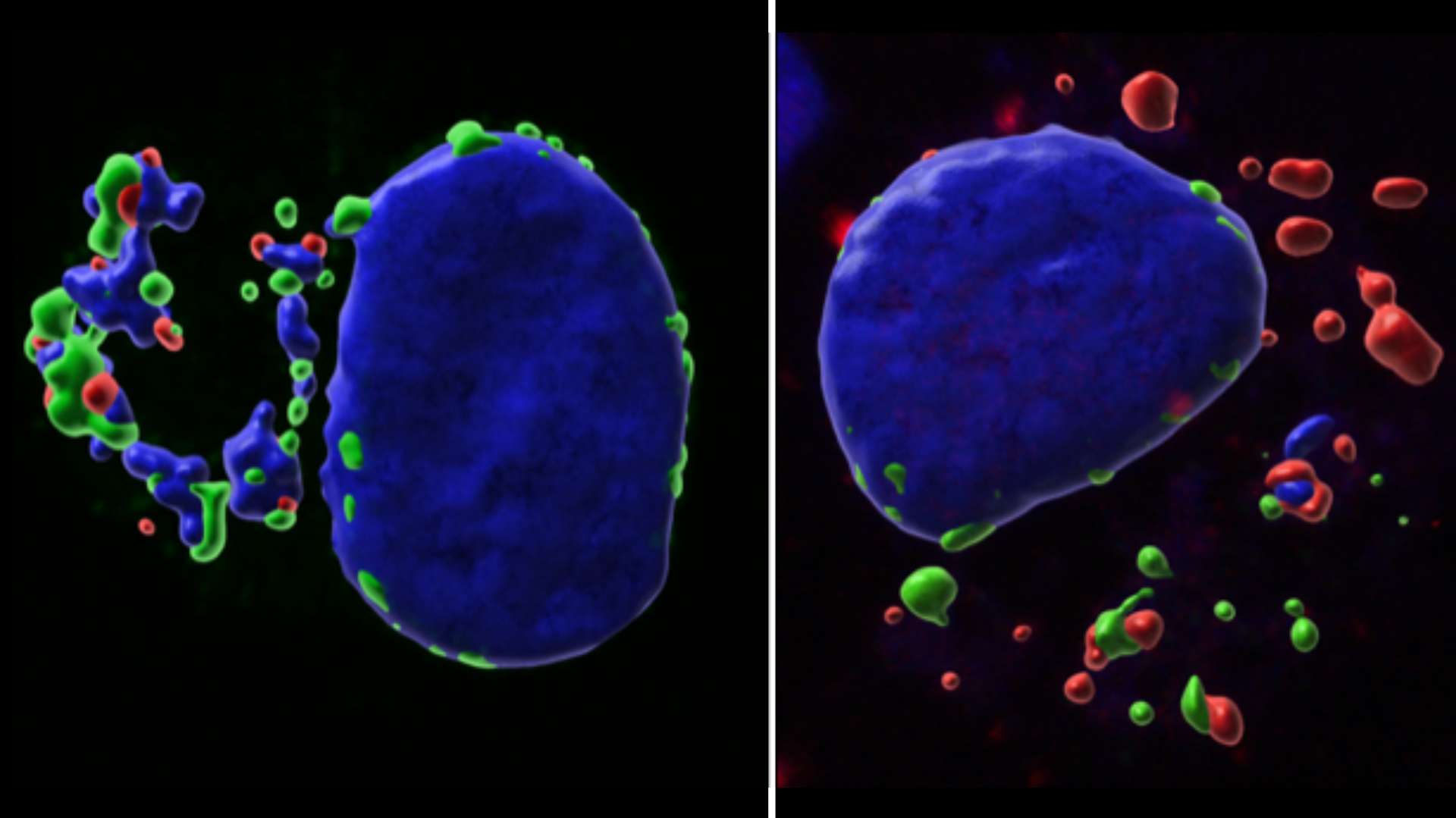
Microscopic images of cells (in blue) treated or not with the compound studied, showing a difference in localisation of the proteins of interest (in green and red) between the two conditions
© Marie Villarès – Université Paris Cité
All mammalian cells have a specialized cleaning process called “autophagy“, which recycles damaged proteins and eliminates invading pathogens. To survive inside host cells, pathogens must find a way to escape autophagy. Theileria annulata, a single-cell parasite transmitted to cows by ticks, causes a fatal disease in cattle in Africa and Asia, with a significant socio-economic impact. This parasite divides and multiplies with the white blood cells it infects, rendering them, like cancer cells, “immortal”.
In a previous study, the team of geneticists and biochemists from the Epigenetics and Cell Fate unit showed that Theileria parasites secrete a protein into the host cell, leading to changes in gene activity in the infected white blood cells and transforming them into cancer cells. This mechanism, never before described in mammals, opened up new therapeutic avenues. However, the parasite had not yet revealed all its secrets. How does it manage to survive in the hostile environment of host cells and evade the immune system?
The Theileria parasite should be eliminated by the host cell’s autophagy mechanism. But somehow this mechanism is not effective against this parasite. By testing hundreds of compounds initially created for their anti-cancer properties, Marie Villares identified a molecule that enables the host cell to eliminate the parasite. Using fancy genomics, proteomics and imaging techniques, she then deciphered the mechanism by which this new compound acts in the infected cell. Marie Villares and the Weitzman research team discovered how the Theileria annulata parasite escapes autophagy to survive in the infected white blood cell. Once inside the cell it infects, the parasite sequesters on its surface a protein (called eIF5A) which is essential for the autophagic cleansing process. As the parasite traps the eIF5A protein, the cell can no longer defend itself. The new compound can efficiently restore the autophagy cleaning process by freeing eIF5A from the parasite’s grip. The autophagy process can then resume its activity within the cell and eliminate the parasite.
This study reveals a new mechanism used by intracellular parasites, such as Theileria annulata, to escape host cell defenses through the process of autophagy. The new compound that releases eIF5A and restores autophagy could be a promising new drug to treat infected cows and eliminate this dangerous pathogen.
This work is the fruit of an international collaboration with a team of medicinal chemists from the Sapienza University in Rome, Italy, and colleagues from the imaging and proteomics technology platforms at the Institut Jacques Monod. Prof. Weitzman’s team is supported by grants from the ANR, the Labex Who Am I?, the Graduate School G.E.N.E. and the Fondation pour la Recherche Médicale (Equipe FRM).
Source
Theileria parasites sequester host eIF5A to escape elimination by host-mediated autophagy – Marie Villares, Nelly Lourenço, Ivan Ktorza, Jérémy Berthelet, Aristeidis Panagiotou, Aurélie Richard, Angélique Amo, Yulianna Koziy, Souhila Medjkane, Sergio Valente, Rossella Fioravanti, Catherine Pioche-Durieu, Laurent Lignière, Guillaume Chevreux, Antonello Mai & Jonathan B. Weitzman
Nature communications – March 12 2024
Marie Villares completed her doctorate in the Epigenetics and Cell Fate unit, supervised by Prof. Jonathan Weitzman, and she is currently a post-doctoral fellow at the Institut de Recherche en Infectiologie in Montpellier. Marie is the winner of the 15th edition of the Prix Jeunes Talents France L’Oréal-UNESCO Pour les Femmes et la Science and competed in the Ma Thèse en 180s international French-language competition. Discover Marie Villares’ performance
Read more

À UPCité, ensemble contre les LGBT+PHOBIES
Université Paris Cité in the spotlight for the 75th edition of the Lindau Nobel Laureate Meetings
For the 2026 edition, three young talents from Université Paris Cité have been selected to take part in the prestigious Lindau Nobel Laureate Meetings in Lindau, Germany. This is a unique opportunity for Federica Namor, Marie Robert and Luca Ferrini to engage with...
read more
Europe is brought to life every day at Université Paris Cité
A European university by its very nature, Université Paris Cité celebrates Europe Month and the symbolic date of 9 May. In an international context that highlights more than ever the importance of unity and cooperation, Europe Day stands out as an essential event....
read more
Equality Memo: key points for understanding LGBTI+ realities
Having clear definitions is a key tool in combating discrimination. This Equality Memo provides a shared frame of reference for understanding concepts related to sexual orientations and gender identities. UPCité : une université européenne Petit paragraphe introductif...
read more